Thought Leader Mohamed Q. Amin on Pioneering New York’s First Organization Dedicated to the Caribbean LGBTQ+ Community
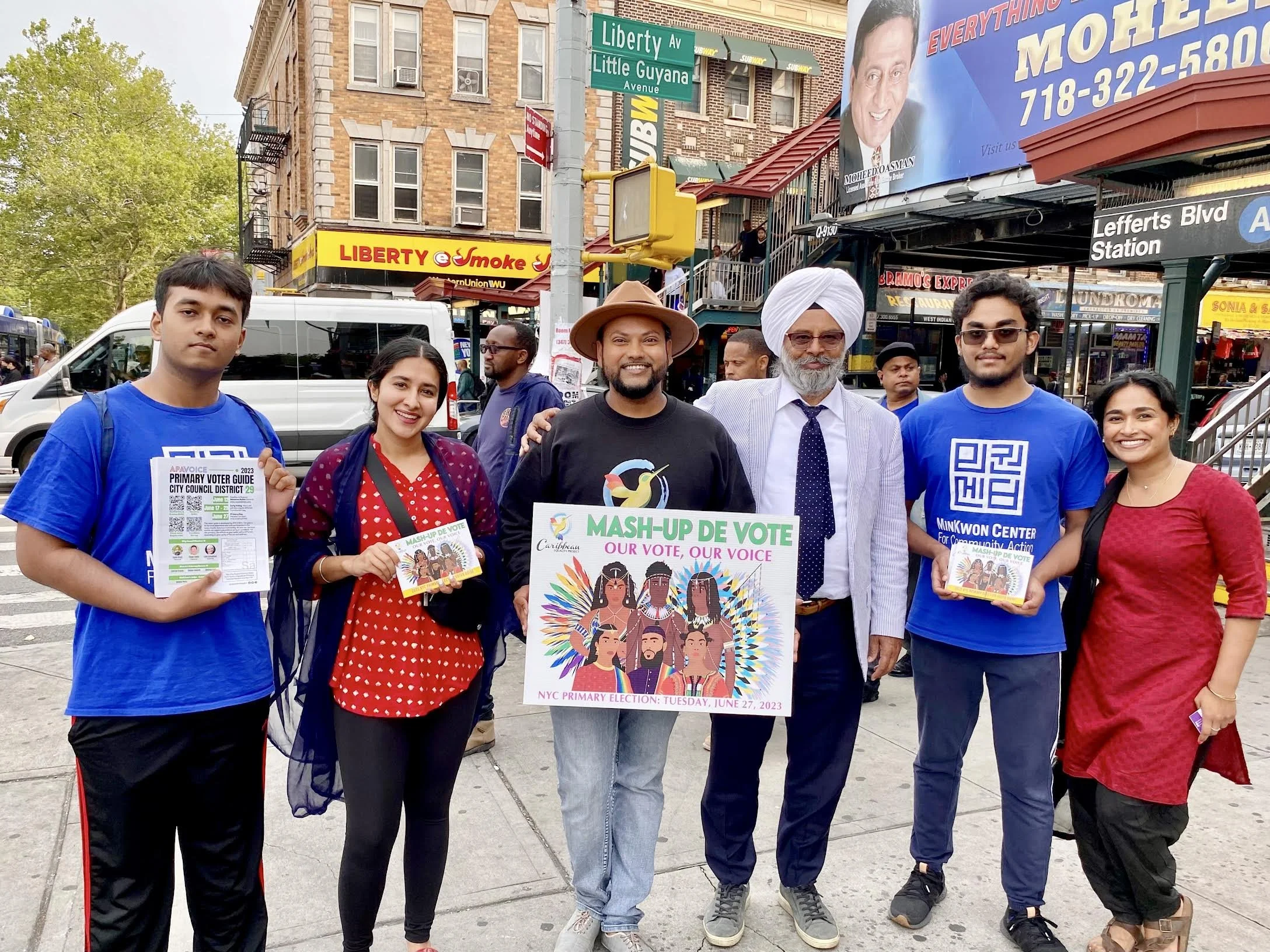
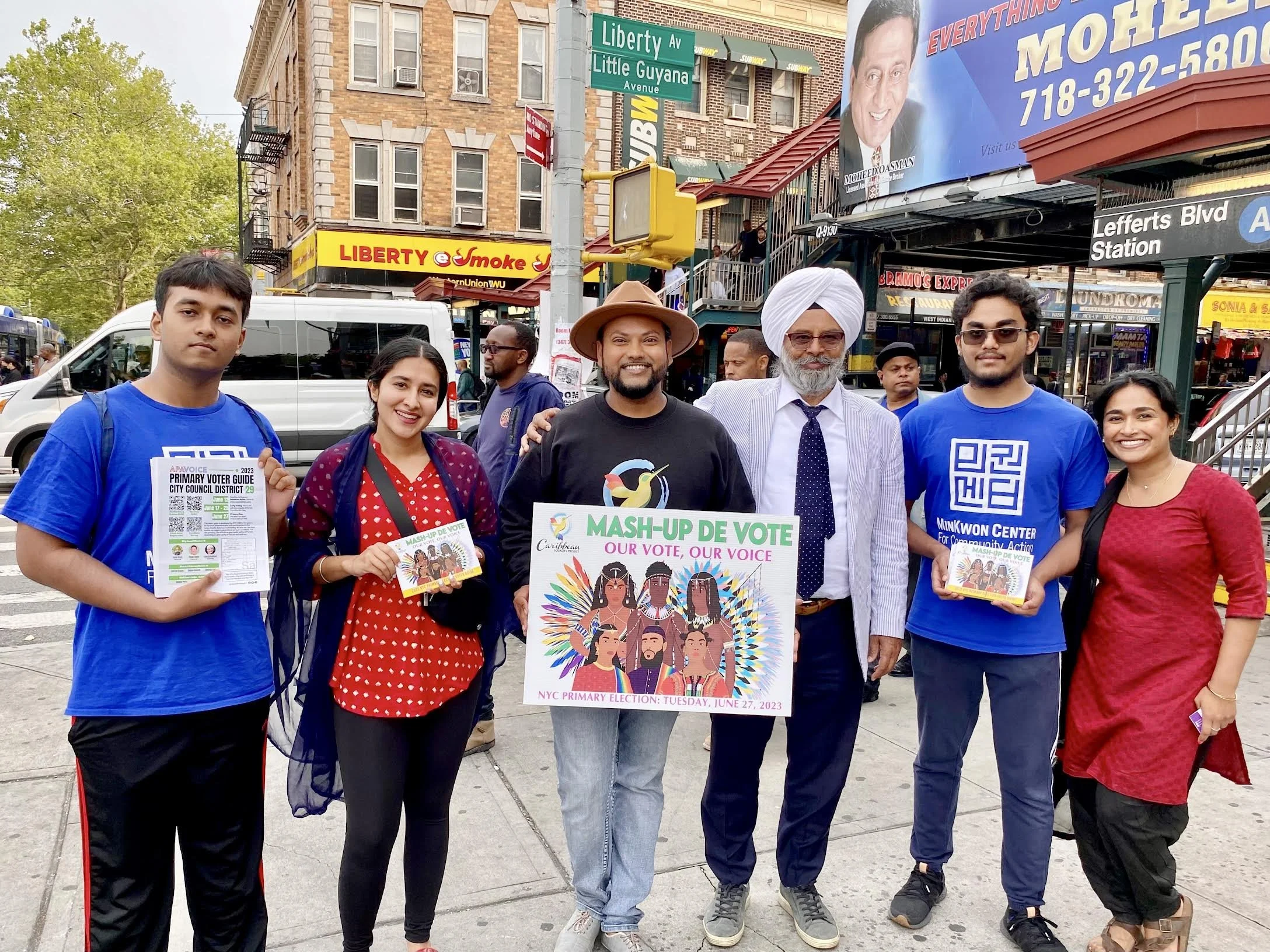
Photo courtesy: Mohamed Q. Amin (in the middle) stands with community members for Mash-Up De Vote
“…these folks used their Tassa instruments…as weapons against us. These cultural celebratory instruments that are used at weddings and religious events and ceremonies became weapons against queer and trans people…”
After enduring a violent attack at a community event, The Caribbean Equality Project (CEP) Founder Mohamed Q. Amin transformed his anguish into a powerful initiative that would go on to provide support to thousands of Caribbean LGBTQ+ individuals in New York.
“My organizing began with creating pride spaces, creating visibility spaces and that led to an anti-LGBTQ incident that my partner, my brother and community members were involved in…” Amin said.
It was March 2013, just two weeks before the NYC Pride March. Amid organizing, Amin and his partner were invited to participate in a curry duck competition at a local bar. An enjoyable night quickly changed tune as an emcee came on the mic, aggressively and derogatorily stating that “the gays are in the building.” Amin and his party were met with a hostile environment following the announcement, particularly after his partner placed second in the competition. Individuals continued making derogatory comments and eventually became violent. Amin’s partner used his body to protect and push Amin out of the venue.
It took two years for Amin and his loved ones to recover from the incident. Left traumatized, they found themselves seeking mental health support along with legal counsel. The incident left a clear message: they weren’t safe in their own community.
“After that incident, I had to reconcile with being queer, being Indo Caribbean, living in Richmond Hill, and not being safe in my neighborhood,” Amin said.
Amin began organizing initiatives in 2010, particularly around the Big Truck tradition. Big Truck was founded in 1997 by the late and beloved Colin Robinson, who was a queer organizer originating from Trinidad and Tobago. Robinson started the tradition as a way to create space for Caribbean LGBTQ+ people at the New York City Pride March. Over the years, this tradition was passed down from organization to organization with Chutney Pride now taking over the tradition from Caribbean Pride under Amin’s leadership.
After the attack, Amin, who identifies as a queer Indo Caribbean Muslim immigrant, felt the community was unprotected. Amin stepped away from Chutney Pride and sought services from the New York City Anti-Violence Project. There he was provided with services that furthered his personal and leadership development, particularly a six-month program called the Speakers Bureau. Following his graduation, Amin imagined the concept for the Caribbean Equality Project.
“I said, I’m going to do something different. Richmond Hill has always been underresourced and underfunded as a community, but it has had no LGBTQ advocacy presence. There’s been no visibility in Richmond Hill of LGBTQ people, even though we know our LGBTQ folks live and exist and contribute to the economy of Richmond Hill,” Amin said.
In 2015, Amin launched the Caribbean Equality Project via social media on June 26 during a monumental moment. The Supreme Court met to determine a hearing for the oral case on national marriage equality. Hours later, the bill was passed.
In the years that followed, the Caribbean Equality Project took off on social media. The organization comprises a board of 12, four part-time roles and a large group of dedicated volunteers. Amin says that as much as the organization is a social services advocacy organization, it is also a survivor-led and survivor-serving organization. Many community members have fled for survival and safety from all parts of the Caribbean. During the COVID-19 pandemic, the organization, like many others, was forced to rethink what community organizing looked like as well as what support their community required.
Photo courtesy: Mohamed Q. Amin, members of Caribbean Equality Project supporting various causes
“One of the first things that happened was that so many of our community members started to lose their jobs, and they lost income. Many of them were undocumented, asylum seekers, and they were community members of ours,” Amin shared.
Many community members began reaching out to the Caribbean Equality Project for support and resources as they lost income and weren’t able to keep up with bills. The team had to pause and consider what their next move was. They began by transforming their Unchained support group into a virtual space and increasing sessions from once a month to twice a month. The virtual spaces were held regularly for two and a half years and reached community members from across the world: the United States, Canada, Trinidad, Jamaica and more.
Outside the Unchained group, the Caribbean Equality Project brought in a mental health counselor and provided dozens of sessions weekly. In addition, they began their food justice work. With the help of community partners, they began organizing food pantries, doing the first Saturday of the month in Richmond Hill, Queens, and then the third Saturday of the month in Flatbush, Brooklyn. Their pantries continued post-pandemic and the organization now serves between 350 and 400 families monthly. To date, their food justice program has served over 135,000 families.
Another key component organized was a COVID-19 emergency relief fund to help economically support their community members.
“During the pandemic, we raised and distributed over $85,000 to over 255 undocumented Afro and Indo Caribbean immigrants,” Amin said.
Caribbean Equality Project works year-round to foster civic engagement within their community as well. Their Mash-Up De Vote campaign, a culturally responsive, nonpartisan voter education campaign, has registered hundreds of voters since it began in 2020.
2024 marks nine years since the organization has been a champion for the LGBTQ+ community. For Amin, the fruits of his labor came full circle when Chutney Pride passed the torch to the Caribbean Equality Project to organize the Big Truck tradition in 2019. Amin says it’s an incredible legacy and honor to continue producing the tradition, as the Big Truck contingent is normally one of the only Caribbean LGBTQ visibility contingents at the NYC Pride march. In their first year, they saw over 3,000 community members march alongside them.
“I look at it as a space of liberation. I always view the carnival road as a place of resistance. In many ways, the Big Truck allows Black and brown, queer and trans Afro and Indo Caribbean people to take up space at NYC Pride where our intersectional identities could be celebrated,” Amin said.
Many projects are on the horizon for the Caribbean Equality Project, as they plan to celebrate their 10th anniversary in 2025 with a gala. Excitingly, Amin is also one of three executive producers of an upcoming short film called Caribbean Queen. You can also look out for him as a speaker at Toronto Pride’s interfaith panel as part of the Human Rights Conference.
Featured
Meet the Two Women Who Are Reclaiming Caribbean Tourism through The Caribbean Green Book