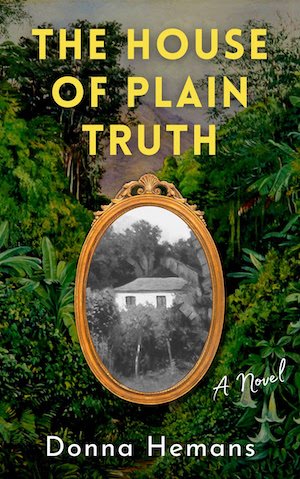
“The House of Plain Truth” by Donna Hemans is a gripping family saga, spanning across Jamaica, America and Cuba over decades. It’s the story of one woman’s search for answers to her family’s uncertain past.
The story tells the journey of Perline, a Jamaican American woman who abruptly leaves behind her daughter and grandchild in Brooklyn to care for her ailing father in her childhood home in rural Jamaica. As he is dying Perline’s father Rupert has one last wish. He asks her to “find them for me” after uttering the names of his four children that he refused to speak of in the last sixty years.
This unclear request sends Perline on a quest across Jamaica to discover who truly owns the land her family’s home sits on and why her family was fractured across Cuba and Jamaica in the early 1900s. During the first half of the 1900s, thousands of Black Jamaican and Haitian migrant workers made their way to Cuba to work on the sugar plantations. In “The House of Plain Truth” Perline’s father was one of these workers, in search of financial security for his family.
When Cuban employment laws changed, migrant workers faced pressure to leave their jobs and return to their home countries. Rupert and his wife Irene left their three eldest surviving children in Cuba with pressure from the government and after facing the sudden loss of one of their sons, Arturo. This painful separation of the family would later come back to haunt Perline in the form of her father as she tried to execute his dying wish.
With lively dialogue and several engaging characters, Hemans’ book is a loud contemplation on what placement, migration and belonging mean to generations of Caribbeans.
Photo courtesy of Donna Hemans
With a strained relationship between her own American-born daughter and herself, Perline finds herself wondering if returning to her childhood home was the best decision for her. When an unexpected nephew from America appears on her front steps weeks after her father’s death, she finds herself questioning once more how family loyalties and dynamics impact the relationships we choose to have.
As a community elder, Perline’s character offers diasporic readers of all ages a sense of acknowledgment of the conflicting sense of home and identity many Caribbean people experience.
“The House of Plain Truth” also informs readers of the violent experiences many Black migrant workers faced in Cuba at the time. Jarring scenes of Rupert’s hardships in trying to provide for his family exist in stark contrast to the joyful scenes of togetherness that Perline shares throughout the book, prompting readers to consider what it means to sacrifice to sustain one’s self.
Through a determined and hopeful protagonist, “The House of Plain Truth” is sure to keep readers turning the page and reflecting on their own sense of belonging.
READ MORE
Inside the Legacy of Desha Rambhajan-Malli: Trinidad’s Most Beloved News Anchor
Gen Z Founder Dalise Lockhart on Inspiration, Identity and Inclusivity
Bahamian Professor Returns to Clark Art Institute as a Research Fellow
Daughters of the West Indies: Remembering My Grandma Bebe and All our Unsung Sheroes