Home / Blog /
written by Shalana Deonarain
When we talk about the wealth of European empires, we often think of gold, spice and sugar. But another, less visible force fueled the colonial machine. Women.
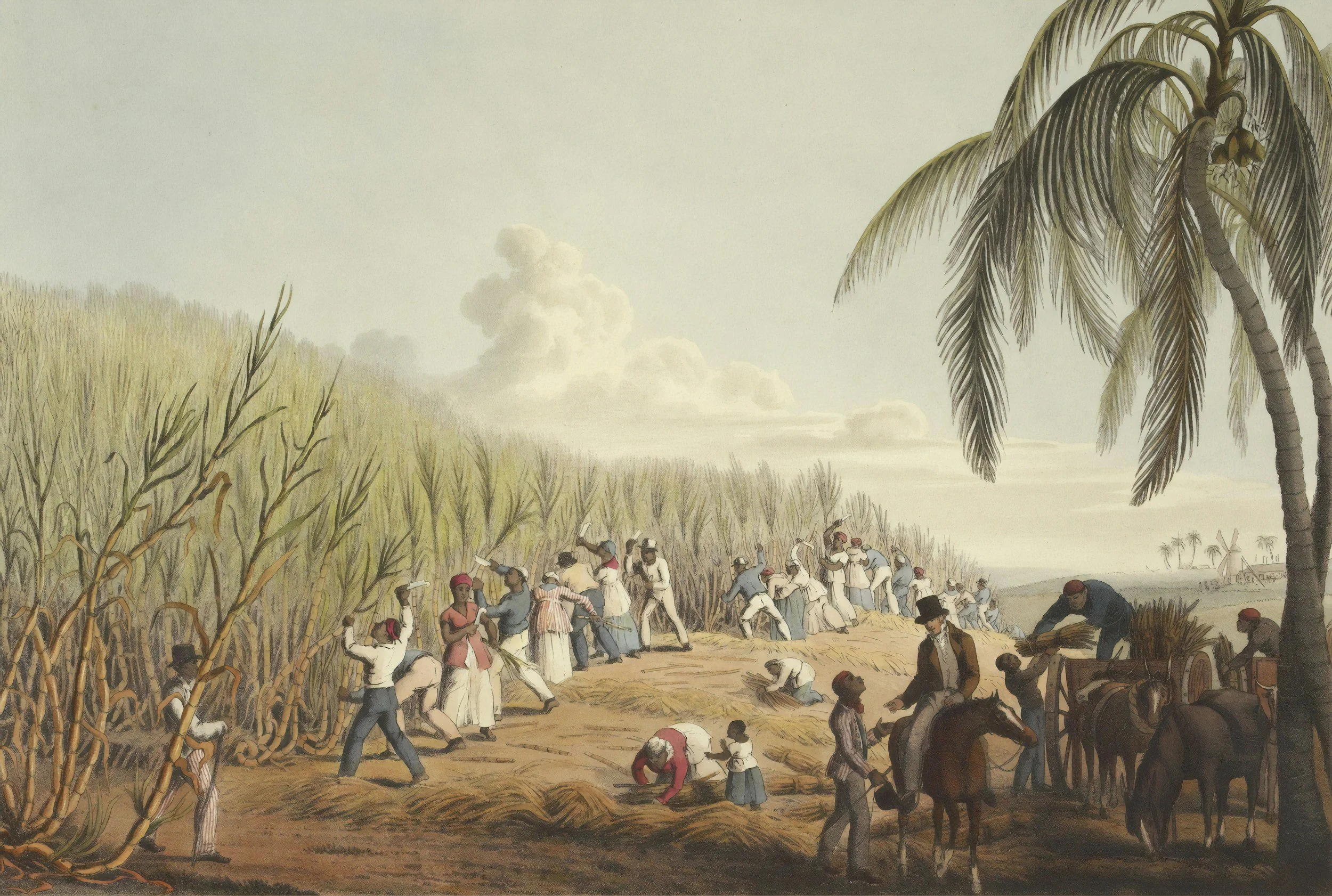
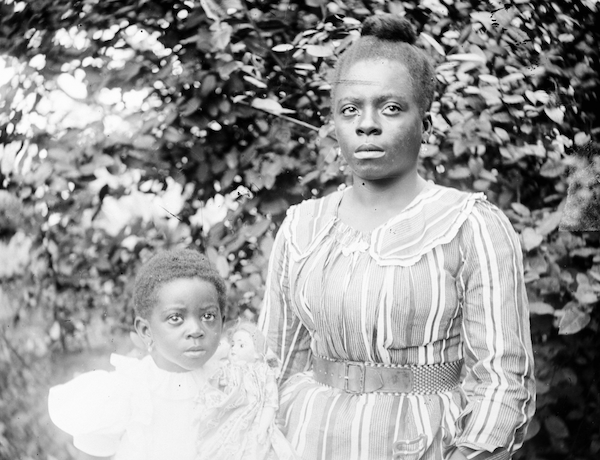
In the heart of the Caribbean’s plantation economy —from Jamaica to Barbados to Trinidad —enslaved women formed the backbone of a brutal system. They harvested sugarcane in sweltering heat, bore children into slavery and lived under laws that treated them as property. Their work was essential. Their suffering, systematic.
Yet their stories have rarely been front and center.
From the 1700s onward, Caribbean plantations were not just farms —they were factories of human labor. Every part of the system was engineered for profit, and enslaved women were central to that equation. Not just as workers, but as reproducers of laborers. As tools of the British Empire.
“They were the invisible engine,” says historian Sasha Turner of Johns Hopkins University, who has studied the role of reproduction in the Transatlantic slave trade. “Women’s bodies were both the labor and the means of producing more labor.”
[Additional Read: Cristiano Berti’s ‘Boggiano Heirs’ Unearths the Pains of Afro Cuban Slavery During Italy’s Pro-slavery Era]
Bodies as Capital
In what would be considered a human rights violation today, plantation owners came to view and treat pregnancy as an economic strategy. Children born to enslaved women were enslaved upon birth, which expanded the labor pool without having to purchase new people. This practice became especially important as the transatlantic slave trade slowed and planters looked inward to maintain their workforce.
It was exploitation in its purest form. A Black woman’s womb was seen as a source of wealth and free labor.
Legal systems supported it, and biblical history, along with skewed interpretations, were used as tools of justification. And social norms reinforced it. Caribbean women were denied the right to own property, to participate in politics, even to parent their children freely. Instead, their roles were reduced to field hands and child-bearers —commodities whose value lay in how much they could produce.
“It’s one of the clearest examples of what we now call racial capitalism,” says cultural theorist Arun Kundnani. Racial capitalism is when racial exploitation is used for capital accumulation. The concept has roots in colonialism and slavery. Enslaved groups were essential to building a capitalist system, yet they were dehumanized and assigned little value, leading to continued exploitation and marginalization. “The wealth generated by these women’s labor and reproduction was funneled out of the Caribbean and into European banks, cities and industries,” says Kundnani.
Race, Gender and Control
While this became an effective system for slave owners —the reality was that it layered oppressions. It wasn’t just slavery. It wasn’t just sexism. It was the intersection of race, gender and class. These women were targeted not just for their Blackness or their womanhood or low social status, but for the combination of the three.
Laws and customs locked them into rigid roles. They were mothers, but not nurturers. Workers, but not citizens. And if they pushed back—if they challenged their roles or refused to comply —they were punished, often violently.
“This wasn’t just economic,” says Caribbean scholar Hilary Beckles. “It was ideological. It was about defining what it meant to be a woman, a Black person, a human being.”
Not Just Victims, but Resisters
Still, despite the suffocating conditions, Caribbean women resisted. Sometimes openly—through rebellion or escape. Sometimes subtly—by preserving cultural practices, raising children with dignity, or finding moments of joy and solidarity in a system designed to break them.
They created Creole languages. Shared healing traditions. Passed down songs and stories that carried memories of Africa and hopes for freedom.
Fred Moten, a poet and theorist, puts it this way: “Even when enslaved, Black women made culture. They made meaning. They made themselves.”
That act of making —of resisting through creation —was itself revolutionary.
The Legacy of Slavery Today
The scars of this system didn’t disappear with abolition. After slavery ended, women remained trapped in similar economic structures. Many were still barred from owning land. Others worked for meager wages on the same plantations that once claimed their ancestors.
Even today, in parts of the Caribbean and across the global South, the legacy of this exploitation lingers, leaving behind a trail of poverty and inequality
In a 2030 agenda for gender equality, UN Women outlines the following statistics:
-
Globally, for women ages 25-34, 122 women live in extreme poverty compared to 100 men in the same age range.
-
In Latin America and the Caribbean, extreme poverty is highest for women ages 25-34. There are 132 women living in impoverished conditions for every 100 men.
-
According to data studied on 89 developing countries, divorced women and girls ages 15 and up are twice as likely to live in poverty compared to their divorced male counterparts. In. Latin America and the Caribbean report the highest number of divorced women living in poverty at 15.8%.
Their labor—whether domestic, emotional, or reproductive—was exploited and undervalued. Yet, their contributions to Caribbean history are immeasurable.
They were builders of economies. Keepers of culture. Bearers of resistance. Their story isn’t just about the past. It’s about how the world we live in today was built —and remembering who paid the price.
Guest Writer: Shalana Deonarain is a graduate from the University of Toronto, where she earned an Honours BA in Equity & Solidarity Studies, and minored in Caribbean Studies and Mental Health and Psychology. As an Indo Caribbean scholar, Shalana’s academic journey reflects her deep commitment to social justice and cultural understanding. With 18 years of experience in Odissi and Bollywood dance, she has a profound connection to her cultural heritage. Aspiring to become a law student, Shalana aims to leverage her diverse background to address issues of equity and justice. Her unique blend of academic achievement and artistic experience has allowed her to make unique contributions to both her community and the legal field.
Read More