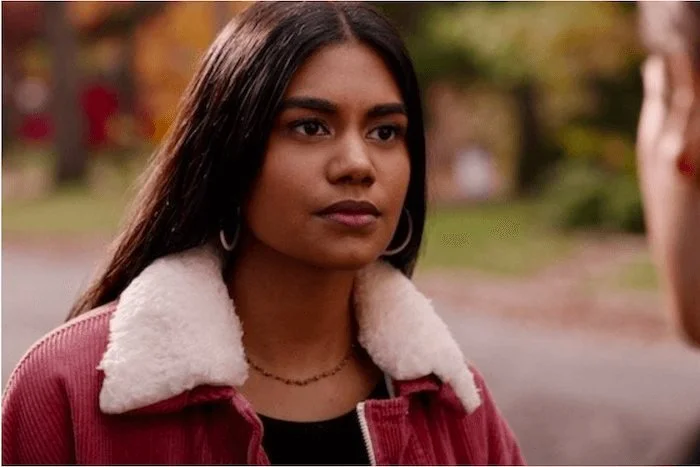
“We would never see a casting call for an Indo Caribbean person. And we are very, very rarely represented in media and in the cultures of the world.” – Rebecca Ablack —
At first glance, Indo Guyanese actress and Netflix star Rebecca Ablack’s Instagram page looks like one of an average 20-year-old with pics of a Brown girl posing and pouting with long, black tresses and stylish clothes. The proud Oshawa, Ontario native calls Scarborough, Toronto home, but you won’t see the Canadian flag emoji in her IG bio. There’s only one flag —the Guyana flag.
And while she mentions her other social media handles, including the one for her hit Netflix show “Ginny and Georgia,” the only weblink listed goes to a GoFundMe page for the Afzal family. According to news reports, four members of that South Asian family were mowed down and killed in London, Ontario in June 2021 by a pickup truck driver who targeted them for being Muslim. It’s obvious her roots are never far from mind.
“I’m a woman of color and I’m living in a world that is built for whiteness,” she said.
Ablack’s parents didn’t let color or culture dictate her future. She started taking singing and acting lessons at a young age and went to a performing arts high school, despite the well-known reticence of Caribbean parents for their children to pursue careers in the arts. She said her mom and dad were supportive even with a lack of Indo Caribbean faces in mainstream entertainment.
“My parents never showed me that you have to worry because they’re not really casting people that look like you,” Ablack said.
The actress took a break from performing to try figure skating but decided to seriously pursue acting at age 15. It wasn’t a hard sell to her parents. Her three other siblings, including brother and actor Raymond Ablack, who plays the restaurant owner Joe in “Ginny and Georgia,” also had agents.
“That’s a dream come true for us to be working on the same show,” she said.
“Ginny and Georgia” is a coming-of-age series that follows biracial teenager Virginia “Ginny” Miller (played by Antonia Gentry whose mother is Jamaican) as she and her vivacious and mysterious white mother Georgia try to put down roots in a picturesque Massachusetts town after years of moving from city to city.
The show is already scheduled for season two which comes as no surprise. According to Marie Claire, 52 million households viewed the series in its first 28 days. Ablack plays Padma, the apparent girlfriend of Ginny’s next door neighbor Marcus though he doesn’t return the love.
“I’m so grateful for everybody that’s like ‘Justice for Padma,’” she said. “They’re really, really invested in Padma’s storyline because I feel like I would be even if I wasn’t playing her.”
While Padma’s ethnicity is never brought up in the show, the role specifically called for a South Asian actress. Ablack said the character is lightly based on one of showrunner Debra Fisher’s best friends.
“I love going in for parts that are specifically South Asian or specifically Brown because you go into the audition room and it’s just a whole group of other Brown women,” she said. “It’s kind of the feeling of like, ‘If I don’t get this, one of these women are going to get it, so it’s kind of like we win either way.”
Ablack added that representation on-screen is of the utmost importance in both ethnically specific and non-specific roles.
“It makes it a lot easier when you see yourself on TV and you’re like, ‘Well, that’s already possible. I don’t even have to imagine it,” Ablack said.
Ablack’s singing lessons paid off, too. She takes the spotlight in one episode by belting out tunes s during a band rehearsal. But there’s still work to be done beyond the casting couch. Ablack recalls working with stylists in the past who didn’t know how to do her hair and makeup.
“I do think that it’s getting better, and that people are becoming more aware and more educated about people of color,” she said. “It’s not one size fits all.”
That’s part of the appeal of the Netflix show that Ablack stars in. Never mind for a moment that the good-looking teen male lead Marcus, who is supposed to be Padma’s boyfriend, is playing her with the new girl Ginny that just moved to town. The series portrays a spectrum of families from biracial and Asian to LGBTQ and hearing-impaired communities.
“We’re supposed to have those conversations. We’re supposed to learn from each other. And I’m glad the show has sparked that kind of dialog with people even within my own friends,” she said. “We’re in a gray zone kind of thing where people don’t think we’re fully Caribbean, but they also don’t think we’re fully Indian or they just think, ‘Oh, you’re fully South Asian.’ There are billions of Indian people who look like us and we’re not all the same.”
Yet, there are some similarities that can’t be ignored across the Indo Caribbean spectrum and the West Indian diaspora at large. She pointed to the Ablack family favorite, Chutney music’s founding father and Trinidadian Sundar Popo as well as her relatives in New York City.
“Everybody knows somebody in Queens,” she said.
And right about now, Caribana would be taking over Toronto. (The main parade and related festivities are being postponed again this year due to COVID.)
“Caribana is one of the main representatives of Caribbean culture in Toronto and that’s where a lot of people know about Caribbean culture, Caribbean food and music and all that kind of stuff. I always feel proud when people are excited for Caribana because I’m like, yeah, that’s us. That’s us.”