“It was not only a win for me, but a win for the Bahamas.” -Keisha Oliver-
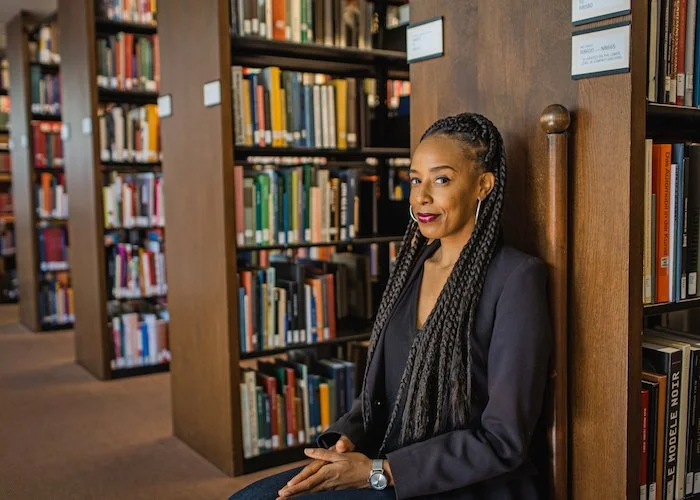
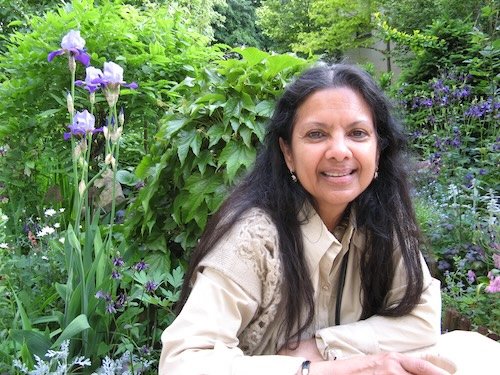
Meet Bahamian artist and scholar Keisha Oliver. Oliver is pursuing an archival project mapping the origins of Bahamian art from the 1950s and 1960s and is the first recipient of The Clark Art Institute’s Caribbean Art and Its Diasporas Fellowship. The art institute is based in Massachusetts and created the fellowship to support art historians, artists, critics and writers.
For Oliver, her interest in art and design began from a young age. She says that her first memory of feeling visible and having her art be seen was in primary school by her art teacher, Bridget Cartwright. Oliver attended high school in the U.K. but spent several summer vacations as a teenager in the Bahamas as a participant of the FINCO Summer Art Workshop for student artists.
The program gave her the opportunity to learn from renowned Bahamian artists and work alongside contemporaries who have emerged as leaders in the creative community today.
“I would say it was definitely one of my proudest moments…I was honored for my proposal to be accepted because it gave way to the visibility of Bahamian art and art history,” Oliver says.
Oliver describes the experience as a stepping stone to creating her narrative as an artist and designer. It was also in the FINCO space where she met her mentor, Antonius Roberts. Roberts is Oliver’s mentor to this day. He has helped her design Summer Arts Immersion, a social art initiative they founded in 2018. The program was created to give a new generation an opportunity for creative learning and mentorship inspired by Oliver’s experiences at the FINCO Summer Art Workshop.
Aside from Roberts, Oliver says that her mother has also had a huge impact on her career and supports her professional advancement.
“I think it’s important to have that support system so that you feel you’re moving in the right direction,” Oliver says.
With dedication and passion for her craft, Oliver’s career took off. In 2011, she was commissioned to create a public arts sculpture for the Lynden Pindling International Airport in Nassau, Bahamas.
She spent roughly a year on the sculpture before applying for a design position at the College of the Bahamas. In 2016, the College of the Bahamas became a university and Oliver was promoted to assistant professor and elected as program coordinator of visual arts. As an educator Oliver has focused on student and community engagement and research. She stressed the importance of making education in the arts more accessible.
Photo courtesy of Ashley Weeks Cart
After four years, she was elected as the inaugural head of the visual arts and design department. Oliver now manages a faculty of six that has worked to develop programming and projects that engage students, alumni, and the wider community, and raise the university’s profile.
“I’m proud of the success we’ve made despite starting a new department during the pandemic. The challenges we faced pushed us to be more critical thinkers and empathetic educators,” Oliver says.
In the summer of 2020, Oliver found herself reflecting and looking to plan the next chapter in her career when she learned about the fellowship. It was her first time applying for a research fellowship and would be her official debut into the art history world. Oliver says the fellowship has been a great opportunity to expand Caribbean scholarships and previously silenced Caribbean stories.
The moment that sparked her idea for her fellowship project came in early 2020 after Oliver’s grandmother Sylvia L. Knowles passed away. She had a moment where she found herself thinking “I wish I knew more about her and her time.” She also considered the concept of storytelling and preserving history, as well as how much has been lost with each generation. Oliver explained that there is no national Bahamian public archive for cultural heritage or the arts. What is available focuses on record keeping managed by The Bahamas Department of Archives.
The first phase of her project began in early 2021, focusing on mapping the origins of Bahamian art. She describes the 1950s as a critical period in the formation of arts education in the Bahamas.
“In the past 20 years, heritage preservation has been lost to a generation of historians and archivists who were really the driving force of post colonialism,” Oliver says.
“I wanted the research to focus on unearthing these marginalized voices within this period of Bahamian visual culture.”
The first goal of Oliver’s project focuses on archival profiles for pioneers in Bahamian art such as Don Russell, Horace Kenton Wright and Homer Milton Williams. She began by collecting information and doing secondary research, interviewing key people who knew the artists such as family and collectors.
In the second phase, Oliver visited the U.S. in search of how remnants of the artists’ and educators’ work could be found there. This included looking up the collectors and institutions that bought and housed their art. Oliver explained that one of the biggest challenges that she faced was finding people she could speak to as many passed away or had faded memories.
Oliver’s longtime goal with the archival project is to create a digital archive that promotes ideas of inclusivity, diversity and accessibility. For a country like the Bahamas that is made up of a chain of islands, digital assets will address the country’s ongoing threat of access to resources and information. Geographically, the island is also threatened by climate changes and natural disasters like hurricanes. A digital archive will help to preserve physical repositories.
“I think it’s very important for any kind of memory worker in the Caribbean to think about preservation protocols that adopt digitization or secondary secure repositories as climate change impacts safety measures,” Oliver says.
Oliver also intends to bring in the element of citizen archivist, noting the importance of private collections and photo albums people have at home. She believes they will be integral to the future of a digital cultural heritage archive.
In the coming years, the scholar hopes to gather more funding to continue the expansion of the archive project and collaborate with like minded scholars and individuals who want to see the vision materialize.
“Once Caribbean communities begin to realize the fragility of cultural memory, the valuable work of emerging scholars and memory workers in the digital humanities will become evident,” Oliver says.
Oliver continues to be inspired by the work of emerging historians, researchers, cultural advocates, memory workers and institutions that strive to showcase Bahamian history and work to preserve it. She is appreciative of the work of of pioneering women scholars like Dr. Gail Saunders, Dr. Erica Moiah James and Patricia Glinton-Meicholas who have paved the way for this research. Oliver continues to recognize how important every contribution is to preserving Bahamian culture.