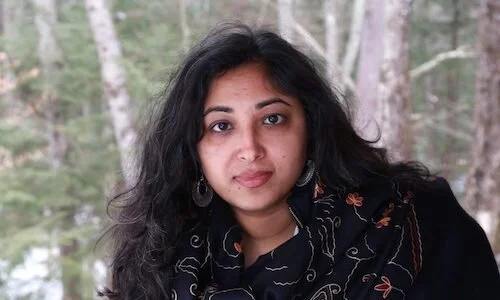
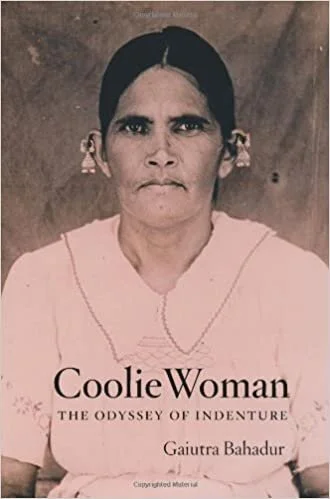
Guyanese-American journalist and writer Gaiutra Bahadur brought two centuries of Indo-Caribbean history to light with her book “Coolie Woman: The Odyssey of Indenture.” Published in 2013, “Coolie Woman”was the product of years of research and questions Bahadur had about her roots, beginning with her great-grandmother Sujaria who travelled from India to Guyana alone and pregnant.
Bahadur first began work on the book in 2008. She spent 10 years working for daily newspapers in Texas and Philadelphia covering the Texas State House, Philadelphia’s courts, the war in Iraq and immigration stories.
“Throughout that 10 years, wherever I was working I was always writing about migrants,” Bahadur said.
Bahadur enjoyed telling the migration stories of others because in some instances her stories were able to help with their cases. One story she covered was of a rape victim from Congo who was seeking asylum. The woman was held in detention in a rural jail in Pennsylvania for over a year waiting for her case to be adjudicated. The story made the front page of the Philadelphia Inquirer and got an immigration judge to release the woman.
Bahadur continued to tell the stories of migrants. In 2007 when a third of the staff at her paper was laid off, Bahadur shifted gears. She won the Louis Stark Fellow (journalism fellowship) from Harvard University. Bahadur considered what she wanted to do next and chose to pursue the story she had thought about for so long—the story of her great-grandmother. Bahadur would go on to win a second fellowship from Harvard in 2016 from the W. E. B. Du Bois Research Institute.
“I was interested in her from the moment I learned of her existence,” Bahadur said.
She recalls the moment she first learned of her great-grandmother. In 1997, after graduating journalism school, her father surprised her with a trip to Guyana. Standing in Newark airport, she asked her father about their family’s connection to India and he explained it was through Sujaria. He had known her as a boy and helped take care of her. During a second trip to Guyana in 2003, Bahadur visited the national archives and was able to find Sujaria’s immigration pass which dated to 1903. The pass indicated intimate details, like a burn mark on Sujaria’s left leg and that she was four months pregnant.
“It was a very good example of the competing and sometimes contradictory sources we have for our history. We have the stories our families have told us, the stories that have come down and then we have the official records and that’s what we have to work with.”
“In ‘Coolie Woman,’ what I tried to do was capture not only the contradiction between the two but the chemistry between the two and to see where the imagination might lead you in reconstructing our history.”
Beginning in 2008, Bahadur spent the next four years in the archives on and off. Her first stop was in London where she spent two weeks looking at correspondence letters between officials in London, Guyana and Calcutta. She discovered conversations about the shortage of women and the quota that was later enacted, requiring certain amounts of women on each indenture ship. She read ship reports and dossiers about uprisings on plantations but notes that while these facts helped fill in the gaps, they were all written by white men. One in particular about the uprising at Rosehall plantation was a key piece to the puzzle. Bahadur’s great-grandmother Sujaria had worked on Rosehall plantation and this uprising ultimately led to the abolition of indenture.
Photo courtesy of Gaiutra Bahadur
Following her two weeks in London, Bahadur travelled to India for the second time. During her first visit she made a stop in Bihar to try and find her great-grandmother’s village. With the help of some biology students, she found what seemed to be the family. On her second visit she came prepared with a guide who was known to help other people of Indian descent locate their ancestral villages. She returned to the same family she had found five years before, but unfortunately, she and her guide did not see eye to eye.
He refused to translate the fact Sujaria worked on a plantation. He explained it would damage the family’s caste (class) if such things were discussed. For Indo-Caribbeans, systems like caste were lost once our ancestors were relocated to the Caribbean. There was little way to enforce and uphold these systems. India’s caste system has been criticized as a means of enforcing systemic classism and discrimination.
Bahadur explained that since writing “Coolie Woman” she has been pulled into a new age movement of “Coolitude” that inspired many Indo-Caribbeans to reclaim the word “coolie” which means unskilled laborer or servant. But her own use of the word in the book’s title came from her interest in the metaphorical possibilities it held, not in making a statement.
“Whenever I heard that phrase in my family or in Guyana it wasn’t derogatory. It was a word that invoked struggle, hardship, burdens and the burdens in particular that women in our history have had to shoulder.”
Since “Coolie Woman,” Bahadur has continued her work on migration within the Indo-Guyanese community. In 2020, she began work on a project titled The Things We Carried, the result of an archival creators fellowship she received through the South Asian American Digital Archive. Bahadur’s project explored the things people brought with them when they came to America, what she refers to as “material memory.” She also focused on oral history, finding stories of Guyanese women between 1920-1960. One story highlighted a woman who came to America alone at age eight with someone else’s documents. She revealed this research is also part of the process for a second book she is working on. The book will in a sense be a sequel to “Coolie Woman,” focusing on the post colonial history of America and Guyana. She explained that the book will follow Guyanese immigrants who went to America in search of “The American Dream,” and tie in the relationship between America and Guyana as well as the political history.
Bahadur’s work as a journalist is extensive. She has also written the afterwords in “Fault Lines” (Feminist Press, 2020), “I Even Regret Night” (Kaya Press, 2019) and has contributed stories to anthology collections “Go Home!” (The Feminist Press at CUNY, 2018) and “We Mark Your Memory” (SAS Publications, University of London, 2018) amongst others. Her essay “Tales of the Sea” won the New Jersey State Council on the Arts Award for Prose in 2019. Bahadur’s writing has been published in a number of newspapers and online publications such as The Washington Post, The Boston Review and The New York Review of Books.
To young Caribbean writers looking to share their stories, Bahadur leaves one last thought.
“So many of us are doing it… I feel like the only advice I can give them is to not let anyone sensor their voices or diminish the legitimacy of their stories… but they know it for themselves and they’re doing it.”
Bahadur’s work continues to be a resource to many in the Indo-Caribbean community. To learn more about the author’s work click here.
READ MORE
Black HERstory: Rebels, Revelers and Revolutionaries
Shelley Worrell: The Cultural Pioneer Who Founded the World’s Only ‘Little Caribbean’ Neighborhood
World Mourns Passing of Two Female Caribbean Icons